
Dec 05, · Introduction In , Lord Esher in Willis V Baddeley has said that “There is no such thing as judge-made law, for the judges do not make the law, though they frequently have to apply existing law to circumstances as to which it has not previously been authoritatively laid down that such law is applicable.” Presently, according to the laws of the parliament, Judges are only allowed to uphold the laws passed by the parliament and not to create or make any new laws or whatsoever. But in some cases or circumstances, Judges have been known to amend and change the laws according to the situation if the judges According to the official line of course the judges do not make law but they do make laws in three circumstances: Interpretation: Parliament cannot define each and every possibility or define and explain every term in statute, so there arises a need for the judge to interpret the statute such that it can be applied to the case before courts
Do Judges Make Law Critique Essay - blogger.com
A law is an obligatory rule of conduct imposed and enforced by the sovereign[1]. Therefore the law is the body of principles recognized and enforced by the state in the application of justice.
The law is mainly made by a parliament, a legislative body given power by the constitution to draft law. However in the last few decades there has been a notion that judges make law. A judge is a public official appointed or elected to hear and decide legal matters in court[2], do judges make law essay, Judges exercise judicial power.
This involves making binding decisions affecting the rights and duties of citizens and institutions. In carrying out this task, a judge can use any of the following three sources of Ugandan law, Acts of Parliament or legislation, the common law, or previous decisions by the courts and a constitution Do judges make law? Hire a subject expert to help you with Do Judges Make Law Critique Essay. Many other scholars more so those that are followers of the realist school of thought have placed absolute emphasis on the discretion of judges and relegated the "rules" to an obscure position.
It can however not be denied looking closely at the present legal system that judges have played a dominant role in moulding the doctrines of the present law for example the common law which is also referred to as judge made law. Nevertheless today no informed observer disputes that judges do especially those of the Supreme Court make law. In the same way the likes of lord Denning moulded the doctrines of the law of contract and otherwise.
To answer if judge make law lets its crucial to analyse how they do so. The application of precedent by judges, whether they are developing the common law for e. in areas such as negligence or murder is the main mechanism whereby judges make law. Precedents are legal principles, created by a court decision, which provides an example or authority for judges deciding similar issues later. Generally, decisions of higher courts are mandatory precedent on lower courts that do judges make law essay the principle announced by a higher court must be followed in later cases.
Occasionally, judges are called upon to give a ruling or make a decision when faced with a situation for which there seems do judges make law essay be no precedent do judges make law essay any guiding rule. In these circumstances, judges can be said to be formulating original precedent thereby using his own discretion regarding when he thinks rules need to be applied, changed, improved, or abolished.
Therefore a judge in using his discretion the phrase commonly used here is that he decides not on precedent but on principle, the difference is that in one case he is applying a principle illustrated by a previous example, in the other case he is employing a case not previously formulated but consonant with the whole doctrine of law and justice.
Further because statutes and common law rules are often too vague and unclear it is often inevitable in "hard cases" for a judge to create new law by deciding cases. The decision of courts of justice when exactly in point with a case before the court are generally held to have a binding authority, as well to keep the scale of justice even and steady because the law in that case has been solemnly declared and determined.
Judges further make law through statutory interpretation. The trend has always been that the legislature makes the law while the judges interpret it, do judges make law essay. Legislation may sometimes be ambiguous or unclear. When this occurs, a court will need to decide between different interpretations of legislation. The common law is judge made law, do judges make law essay.
It has been developed by the courts. It continues to be adapted to meet new situations and changing circumstances. The role of judges in interpreting legislation and the Constitution is similar.
The Constitution is written in more brief and general language than most Acts of Parliament, do judges make law essay.
This is because it is expected to last longer and be able to accommodate changing circumstances. This style leads to a greater range of interpretations. Over the years, the Supreme Court has made decisions which have affected the practical operation of the Constitution.
The parliament which is in charge of law making cannot amend each and every law simply because it fast becoming obsolete. Judges must take the law into their own hands to and interpret the do judges make law essay to an extent that is reasonable and in the bounds of law and reason thus they should generally accept responsibility of reforming the law in the interests of clarity, efficiency and fairness.
If he has to decide upon the authority of natural justice or simply the common sense of the thing he employs the kind of natural justice or common sense which he has absorbed from the study of the law and which he believes to be consistent with the general principles of English jurisprudence. This is evidence of the power of the do judges make law essay in their ability to create law through there simple interpretation of the law.
However it should be noted that this is not a power readily available such that it can be used at the courts convenience. However the word make should be used with extreme caution, do judges make law essay. The above argument is one that can also be used to support the fact that rather than make law, judges simply declare law. According Lord M. Why judges do not make law The Constitution provides for a complete separation of judicial power. This is one limitation on judges because it prevents courts from exercising powers which are not "judicial" in character.
The constitution of the republic of Uganda provides for that existence of three arms of government, do judges make law essay, all vested with powers that are in all ways distinct. The parliament by virtue of the constitution is that charged with the duty of making law. Thus the separation of powers is a political and administrative tool that holds the pillars democracy together. And in a country under the rule of law the judiciary with its well defined limits cannot step into the shoes of the parliament.
The constitution is the most supreme law of the land and its prohibition of the other arms of government to make law should be taken seriously thus if the judiciary is exercising such a powerful role, it should be more open to criticism and the contempt power should be used only rarely. Otherwise, it will reflect on the judiciary as a dictator Further the rules of statutory do judges make law essay further bar judges from making law.
Its generally agreed that in order to interpret statutes judges must use precision based procedural rules. Statutory interpretation employs the literal rule, the golden rule and the mischief rule. They are guidelines that must be followed in the interpretation statutes. Therefore a judge who formulates a legal principle for the first time does so as an existing part of the law and not as a legislative innovation of his own.
In general, principles are identified by showing that they are embedded in the established rules and decisions, The rules of precedent. A precedent is a Legal principle, created by a court decision, do judges make law essay, which provides an example or authority for judges deciding similar issues later. Precedents are the source of most of judge made law. The common law practically evolved out of precedents.
However precedents are bound by rules that limit law making by judges, do judges make law essay. Decisions of lower courts are not binding on higher courts, although from time to time a higher court will adopt the reasoning and conclusion of a lower court. Decisions by courts of the same level usually appellate courts are considered persuasive authority.
That is, they should always be carefully considered by the later court but need not be followed. The constitution states that all laws must have a binding effect on all persons and authorities. Precedents in their inability to be binding on courts that is higher than them and do judges make law essay only a persuasive to courts of the same level dilutes their ability to be termed as laws or have the ability to act like laws.
Further to render precedents valid they must be founded in reason and do judges make law essay must have been made upon argument, and be the solemn decision of the court; and in order to give them binding effect there must be a current of decisions therefore court judges are not at liberty to exercise their freewill but rather their discretion must pass the test of fairness and reasonability. Judicial power involves making binding decisions, do judges make law essay, affecting the rights and duties of people and institutions, by reference to existing law.
Existing law is found in legislation, judicial decisions or common law, and the constitutions. In applying any of these sources of law, judges make law to a limited degree. The power to make law is primarily vested in the parliament and under the constitution judges are under no obligation to make law.
Judges are most paramount at this stage because they cannot send laws back for rectification simply because the times have changed. Indeed the power to make law is one that is not vested in judges but it cannot be denied that to some extent they actually do make law. Do Judges Make Law Critique Essay. Free Essays - PhDessay. com, Apr 13, Accessed August 1, comApr In the Kelo vs. the city of New London case the decision made was that the municipal development statute that was behind the taking of the land was correct as.
Thank You Molly! Good morning respected judges, my fellow contestants and members of the audience. Today we are indeed honoured and privileged to stand before you and speak against the.
Through Barry, Hare shows not. Interestingly, Hare never. In Act 2 Scene 3, we witness the events taking place inside the. The frequency table reveals how many presidential appointees each president made to the Federal Appellate Court bench. This calculated on a per year basis shows that their has been a. According to organ donation information by this time the following day, 20 humans in america who're alive right now might be lifeless and 20 human beings will die due to.
The companies Act does. Does UK Trademark law offer enough protection for Fashion Brands? Introduction Alligator and Crocodile[1]. A crocodile which faces left and a crocodile which faces right[2]. We use cookies to give you the best experience possible. PhD Essay government Constitution Do Judges Make Law Critique Essay.
Table of contents. Related Essays Do judges make law essay Judges Make Law Critique Essay Do Judges Make Law Critique Essay. Hire writer. Do Judges Make Law. Do judges make law essay type Research. Activist Judges on the American Political system.
Do Judges Make Laws?
, time: 8:19Do Judges Make Laws? Essay - Words
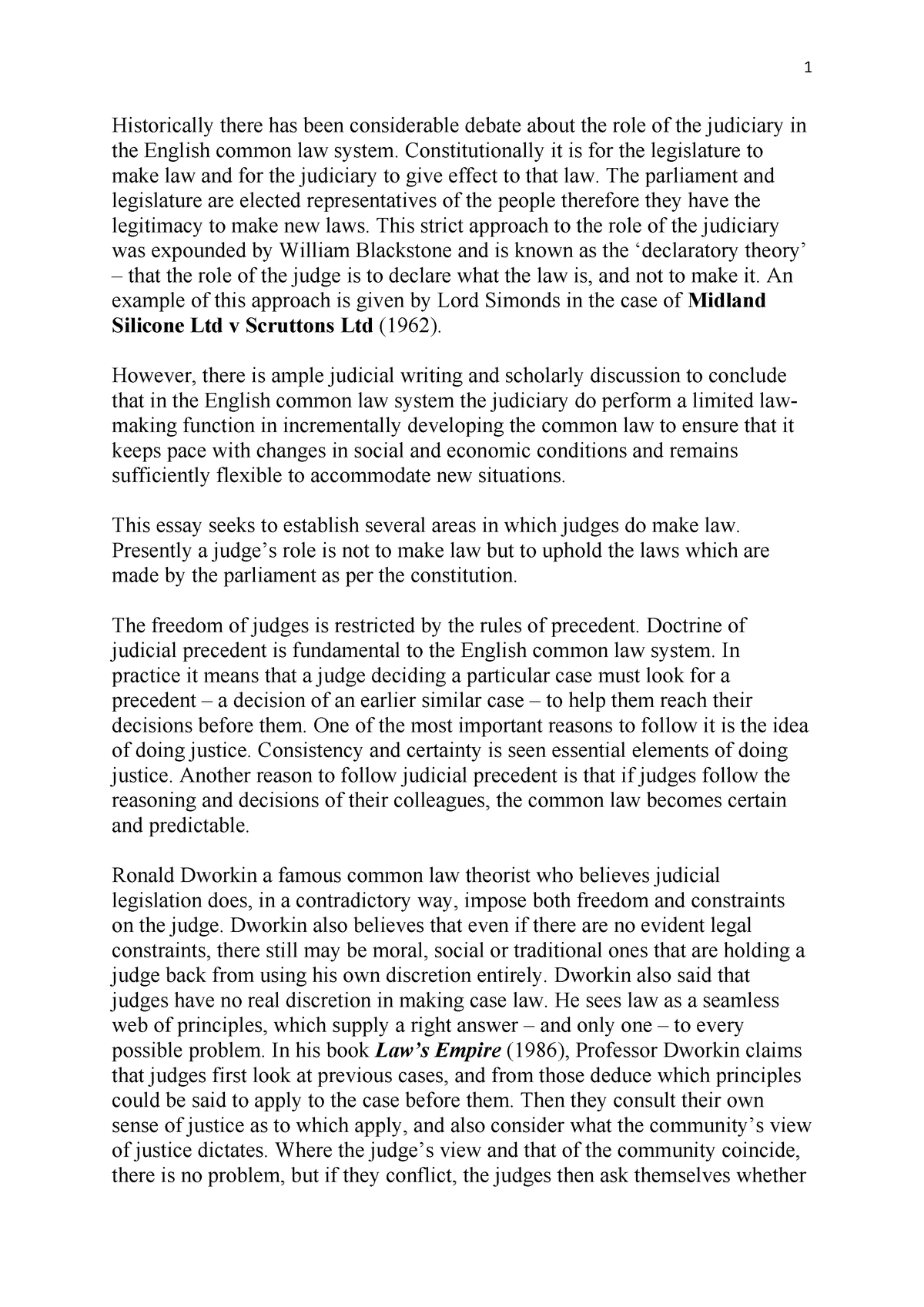
Dec 05, · Introduction In , Lord Esher in Willis V Baddeley has said that “There is no such thing as judge-made law, for the judges do not make the law, though they frequently have to apply existing law to circumstances as to which it has not previously been authoritatively laid down that such law is applicable.” Presently, according to the laws of the parliament, Judges are only allowed to uphold the laws passed by the parliament and not to create or make any new laws or whatsoever. But in some cases or circumstances, Judges have been known to amend and change the laws according to the situation if the judges According to the official line of course the judges do not make law but they do make laws in three circumstances: Interpretation: Parliament cannot define each and every possibility or define and explain every term in statute, so there arises a need for the judge to interpret the statute such that it can be applied to the case before courts


No comments:
Post a Comment